

Alcohol is one of the most widely used substances of abuse among youths and it is a growing public health concern in Nigeria (Olujide et al, 2019). Several studies on alcohol indicate that within the last few decades, there has been a rapid increase in alcohol availability, production, importation, and consumption across all age groups in Nigeria (Victor et al, 2018). The availability and easy access to alcohol have been identified as a contributory factor to the increasing alcohol consumption among minors
Given this, the Distillers and Blenders Association of Nigeria (DIBAN) in collaboration with the National Agency for Food and Drug Administration and Control (NAFDAC) conducted a survey in 2021 on Underage Drinking and Abuse of Alcohol in Nigeria. DIBAN sponsored the study which was conducted by Research and Data Solutions Ltd, Abuja.
The overall objective of the research is to undertake a national survey of consumers and retailers of alcohol beverages and wines, between June and August 2021 to determine the extent of alcohol abuse among underaged persons in Nigeria.
A total of 1,788 respondents in six states across the six geo-political zones of the Country were approached and included in the survey after they agreed to participate in the quantitative survey using a multiple choice questionnaire. Both the data collectors and enumerators were trained for the survey.
Access to alcohol by minors and underaged
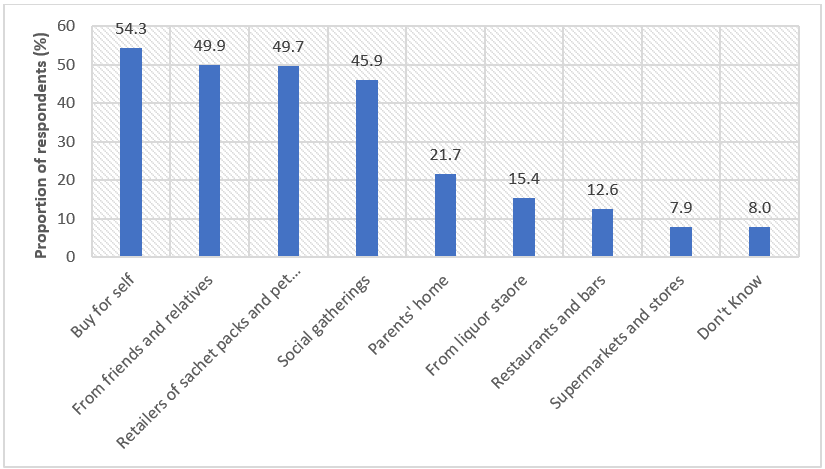
The Figure below presents the percentage distribution of minors and underaged children according to their level of access to alcoholic beverages. Findings suggest that 54.3% of minors and underaged obtain alcohol by themselves from various sources however, 49.9% of them patronize retailers of drinks sold in sachet packs and pet bottles. A lower proportion of this population patronize liquor stores (15.4%), restaurants (12.6%), and supermarkets (7.9%). Findings further suggest that minors and underaged also access alcoholic drinks from friends and relatives (49.9%) as well as from social gatherings (45.9%).
Of those who procure drinks for themselves, 47.2% of minors and 48.8% of underaged procure drinks in sachets, while 41.2% of minors and 47.2% of underaged procure drinks in pet bottles and 27.6% of underaged procure alcohol in glass bottles. The procurement of drinks in sachets and PET bottles reported mostly in Rivers (68.0% and 64.5%), Lagos (52.3% and 47.7%), and Kaduna (38.6% and 28.4%) states compared to other study states, see Figure below. The proportion of drinks procured in sachets is higher among males (51.4%) compared to females (41.5%) and more in rural (50.1%) compared to urban (45.3%) locations.
How minors and underaged access alcohol
Frequency of alcohol consumption by minors and underaged
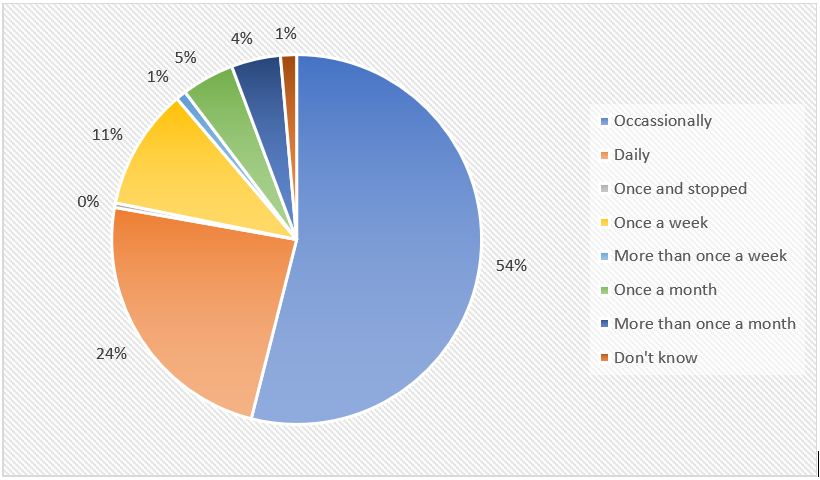
Figure 3 presents the percentage distribution of respondents according to the frequency of alcohol consumption. Findings from Figure 3 suggest that majority of the respondents (54.0%) are occasional drinkers, while 24.0% drink alcohol daily and 11.0% drink alcohol at least once a week.
Further analysis of the survey data revealed that 63.2% of minors and 54.0% of underaged drink alcohol occasionally, while 44.3% and 38.3% of adults drink alcohol occasionally and daily respectively. Additionally, 9.3% of minors and 25.2% of underaged children consume alcoholic beverages daily and 11.3% of minors and 9.4% of underaged consume alcohol at least once a week. See Table 6 for more findings on this.
Frequency of alcohol consumption respondents
Summary of findings
- Most minors and underaged (54.3%) buy alcohol for themselves
- On access to alcohol, 49.9% of minors and underage access alcohol from friends and relatives, 45.9% of them at a social gathering, and 21.7% from parents’ homes.
- Of the minors and underage who procure drinks for themselves, 47.2% of minors and 48.8% of underaged procure drinks in sachets, 41.2% of minors, and 47.2% of underaged procure drinks in pet bottles while 27.6% of underaged procure alcohol in glass bottles.
- Most minors (63.2%) and underage (54.0%) consume alcohol occasionally.
The pattern of alcohol consumption and abuse by minors and underaged
The survey findings revealed that 2.5% of minors and 11.7% of underaged children had ever engaged in binge drinking. This is mostly reported in Gombe (16.3%), the FCT (15.0%), and Anambra (14.4%) states.
Reasons for alcohol consumption
The survey data also revealed that minors and the underaged drink alcoholic beverages because of peer pressure (50.5%), influence by parents and relations (34.8%), or personal choice (34.2%) while others believe that minors and underaged drink alcohol because they are sad and depressed and may want to feel good (34.0%).
The data presented in Figure 4 corroborate these findings because the factors that contribute to alcohol consumption among the underaged include peer group pressure (74.5%), youths themselves (49.4%), parents/family relations (39.7%), and social media (36.4%) as well as other factors such as the accessibility of alcohol/liquor outlets (32.6%), the role of government (22.7%) and public advertisement of alcoholic beverages (20.7%).
Underage Drinking and Impact on Health (From Medline and Center for Disease Control)
- Brain Development: Alcohol can damage the hippocampus (memory center) and prefrontal cortex, leading to permanent issues with learning, memory, and impulse control.
- Immediate Dangers: Binge drinking is common, risking alcohol poisoning, which can cause fatal shutdowns of breathing and heart rate.
- Physical Health: Underage drinking is linked to liver and kidney damage, hypertension, disrupted hormone growth, and increased cancer risk later in life.
- Mental Health: It increases risks of depression, anxiety, and low self-esteem.
- Addiction Risk: Youth who begin drinking before age 15 are 41% more likely to become dependent on alcohol.
Behavioral and Social Consequences
- Violence and Injury: Alcohol is a major factor in youth suicides, homicides, and motor vehicle crashes or accidents.
- Risky Behavior: It is strongly linked to unprotected sexual activity, unwanted pregnancies, and sexually transmitted infections (STIs).
- Academic Problems: Drinking often leads to lower grades, missed classes, and impaired cognitive function.
The above findings underscored the following Senate resolutions made on November 6, 2025 that were communicated to SGF on December 1, 2025 to:
- Urge NAFDAC not to grant further extension to the moratorium and to ensure immediate strict enforcement of the ban on sachet alcohol and alcohol in smaller (<200ml) PET bottles
- Urge the Federal Ministry of Health and Social Welfare to support NAFDAC on the ban on sachet alcohol and alcohol in smaller (<200ml) PET bottles
- Urge Federal Ministry of Health and Social Welfare to release the National Alcohol Policy that includes prohibition of alcohol in sachets and small volume (<200 ml) packagings
- Urge National Orientation Agency and NAFDAC to collaborate and intensity nationwide sensitization of dangers of alcohol in sachets and small volume bottles and consumption of the products.
Conclusions
- Access to alcohol by children can be limited if pack sizes (sachets and small volume bottles) that can be easily concealed are not available
- Ban on small pack sizes (sachet and less than 200 ml bottles) can reduce the menace of underage drinking
- Consumption of alcohol should raise alarm for parents, teachers, religious leaders and the community at large
- NAFDAC and NOA are collaborating to significantly increase the awareness and sensitization
NAFDAC: Safeguarding the Health of the Nation!!!